



This article is part of FilecoinTLDR’s use case exploration series, where we look at real-world problems that Filecoin’s verifiable storage layer can help address.
Introduction
Modern data systems are constantly changing. Records are cleaned, labels are updated, new fields are added, and datasets are repeatedly reused across models, reports, and automated workflows. As a result, the data available today may no longer match the data that produced an earlier output or decision.
When that output needs to be investigated, keeping only the latest version is not enough. Teams need to reconstruct the earlier data state – including the dataset version, schema, labels, processing logic, metadata, and model context that were active at the time.
This is the past-data-state problem: the underlying files may still exist, while the broader context needed to explain, reproduce, or verify a result has been lost or scattered across different systems.
In this blog post, we’ll explore why this matters:
- Modern data systems are in constant flux
- AI and analytics demand reproducible states
- Audits and compliance require trustworthy evidence of what actually existed at the time
We’ll then look at how Filecoin’s content addressing and verifiable storage can help anchor these critical data states over time.
1. Modern data systems are in constant flux
The first reason past data states matter is that modern data systems are rarely still. In AI and analytics workflows, data is constantly being updated, cleaned, labeled, combined, filtered, and reused across different tools.
A customer dataset may start as raw records from an app or database. Before it is used, the team may clean errors, add new fields, update labels, remove duplicates, or combine it with other datasets. Later, that same data may be used to train a model, power a dashboard, support a report, or feed an automated workflow.
Each change may be reasonable on its own. The problem is that, over time, these changes make it harder to know what the data actually looked like when a specific model output, report, or decision was produced.
Consider an AI credit model used to assess loan applications or repayment risk. If the model begins denying applications differently after an update, the team may need to determine which dataset, model version, labels, and decision logic produced the earlier results. Without access to that original state, it becomes harder to identify what changed, explain a decision, or roll the system back safely.
That is why modern data platforms increasingly talk about “time travel,” “data versioning,” and “lineage.” In plain terms, teams need ways to look back and see the version of the data that existed at a specific moment, not only the latest version available today.
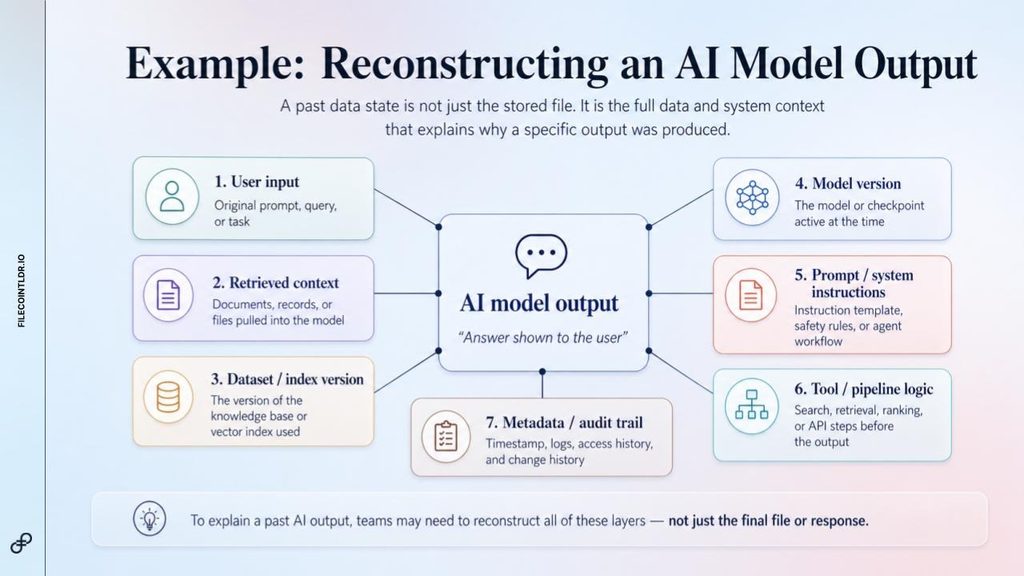
A past data state is therefore more than a stored file. It includes the data itself, the labels attached to it, the rules used to process it, the version of the system that used it, and the context that gave it meaning. Without that context, teams may still have the data, but lose the ability to explain how it was used.
2. AI and analytics depend on reproducible data states
AI and analytics workflows are especially exposed to this problem because their outputs depend on many things working together at once.
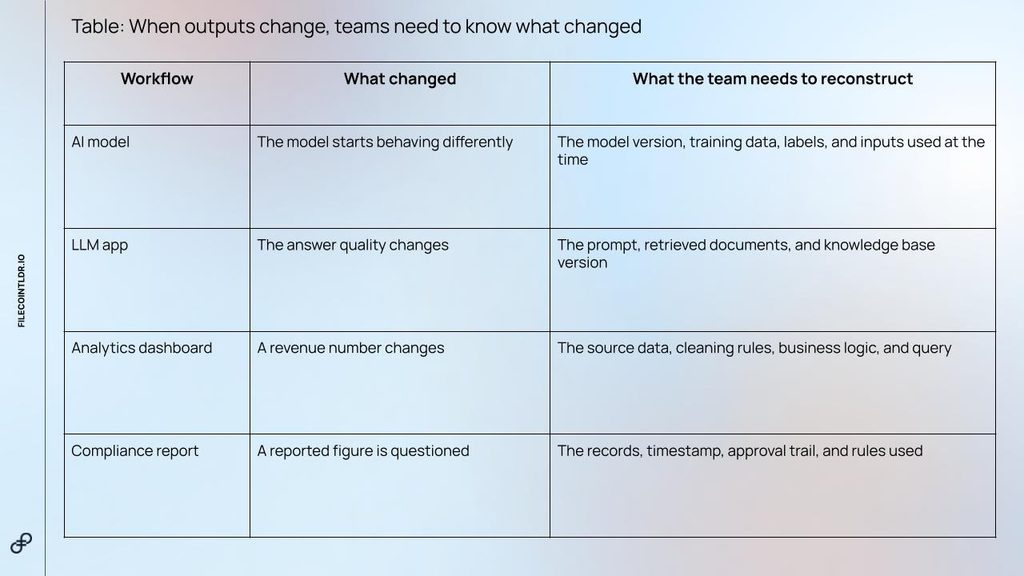
An AI model does not produce a result from “data” in the abstract. It uses a specific version of the data, a specific model, and a specific set of rules or instructions. An analytics dashboard is similar. A revenue number may depend on the source data, the way that data was cleaned, the business logic used, and the query behind the report. When any of these inputs change, the output can change too.
That is why reproducibility matters. If a model starts behaving differently after retraining, the team needs to know what changed. Was the model updated? Did the training data change? Were labels corrected? Did the retrieval system pull in different documents? Without the ability to return to the earlier version of the data and system context, teams may only be guessing.
This shows up in real AI incidents. In a 2025 postmortem, Anthropic explained that its privacy and security controls limited how and when engineers could access user interactions with Claude. Those controls protected user privacy, but they also made it harder for engineers to examine the problematic interactions needed to identify or reproduce certain bugs. The lesson is not that privacy controls are bad. It is that AI reliability often depends on having enough historical context to investigate what actually happened.
Analytics teams face a similar version of the problem. If a revenue dashboard changes after a data pipeline update, leaders need to know whether the business changed or the reporting logic changed. Without the ability to recreate the earlier data state, the team may struggle to explain why last month’s number no longer matches this month’s report.
This is why technical practices like experiment tracking, feature versioning, and data lineage matter. In plain terms, they help teams answer a simple operational question: can we go back to the exact data and system context that produced this result?
3. Audits and compliance require trustworthy evidence of what actually existed at the time
The third reason past data states matter is that some questions are not only technical. They are about evidence.
In an audit, investigation, compliance review, or disputed business decision, it may not be enough to show the data that exists today. The team may need to show what the data looked like at the time, which version was used, what changed later, and whether the original state can still be recreated.
In some regulated industries, this is already a formal requirement rather than simply a technical best practice. The SEC’s electronic recordkeeping rules, for example, require broker-dealers using an audit-trail approach to preserve records in a way that allows the original record to be recreated if it is modified or deleted. In January 2025, the SEC charged twelve firms with recordkeeping failures, resulting in $63.1 million in combined civil penalties.
Finance is one example of a broader operational need: as AI systems are used in more consequential decisions, organizations may increasingly be expected to show not only their current data, but the exact data and system state behind a past outcome.
This matters because business systems keep moving. Reports get updated. Datasets are cleaned. Fields are added or removed. Model inputs are changed. If no one preserved the earlier version, the organization may struggle to explain what a system actually knew when it made a decision.
Modern data platforms already recognize this need. Features like time travel, data versioning, and historical snapshots help teams look back at earlier versions of data. But these features are usually designed for short-term recovery and debugging, not multi-year audit timelines.
Time travel helps, but audit timelines can be longer
| Platform | Typical retention window | Limitation |
| Snowflake | 1–90 days | Historical data is no longer available for querying after the retention period ends |
| BigQuery | 7 days + 7-day fail-safe | Time travel does not restore table metadata |
| Delta Lake | ~30 days by default | VACUUM can permanently delete historical data files |
The takeaway is not that these tools are weak. They are useful for fixing recent mistakes, checking recent changes, and rolling back short-term issues. But for datasets tied to audits, revenue reporting, model validation, or compliance, teams may need to preserve important versions for much longer.
That creates a gap between short-term recovery and long-term evidence. A system may be able to show what changed last week, but not the exact data version that supported a model, report, or business decision months or years ago.
For high-stakes data, the requirement is stronger: organizations need to preserve the right version, prove what existed at the time, and keep that evidence trustworthy long after the original system has moved on.
Bridging the gap with Filecoin
The missing layer is long-term proof.
Time travel, lineage tools, model registries, and audit logs can help teams understand which version of data was used. But over longer periods, teams also need confidence that the underlying files, snapshots, and records still exist and have not been silently changed.
This is where verifiable storage becomes useful. Instead of treating storage as a passive place where data sits, verifiable storage turns important data artifacts into something that can be referenced and checked over time.
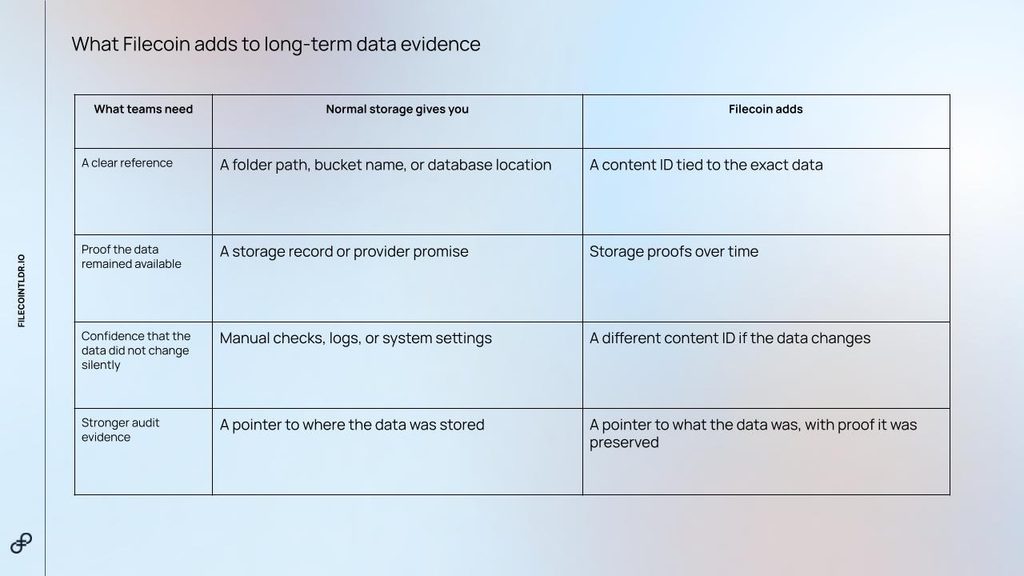
Filecoin helps at this base layer through two ideas: content addressing and verifiable storage.
Through content addressing, important data artifacts can be referenced by what they are, not just where they are stored. A dataset snapshot, model artifact, evaluation set, audit log, or compliance record can be tied to a content identifier. If the content changes, the identifier changes too.
Verifiable storage adds another layer: evidence that the data has been stored over time. This gives teams a stronger way to preserve and later check the artifacts behind a model output, report, or business decision, even after normal time-travel windows expire.
For teams that already use cloud object storage, Fil One offers a more practical way to bring this into existing workflows. It provides S3-compatible object storage, so teams can connect existing tools, SDKs, and storage workflows without redesigning their entire data stack. When datasets or artifacts are uploaded, they can be tied to content identifiers and checked over time, giving teams a stronger record of what was stored and whether it still matches the original data.
Together, Filecoin and Fil One give teams a practical way to preserve important data artifacts beyond the normal lifespan of short-term recovery tools. Dataset snapshots, model artifacts, evaluation sets, audit logs, and compliance records can be stored, referenced, and checked over time. Filecoin provides the verifiable storage layer, while Fil One makes that layer accessible through familiar S3-compatible workflows.
Keep exploring Filecoin
- Try Fil One – verifiable, S3-compatible storage on Filecoin, free for 30 days.
- Follow FilecoinTLDR for ecosystem explainers and updates.
- Join the Filecoin Discord to connect with the community.
- Start the Filecoin Quest Hub to learn, complete quests, and get involved.
- Subscribe to the newsletter for future posts and insights.