This article is part of FilecoinTLDR’s use case exploration series, where we look at real-world problems that Filecoin’s verifiable storage layer can help address.
Introduction
Modern data systems are constantly changing. Records are cleaned, labels are updated, new fields are added, and datasets are repeatedly reused across models, reports, and automated workflows. As a result, the data available today may no longer match the data that produced an earlier output or decision.
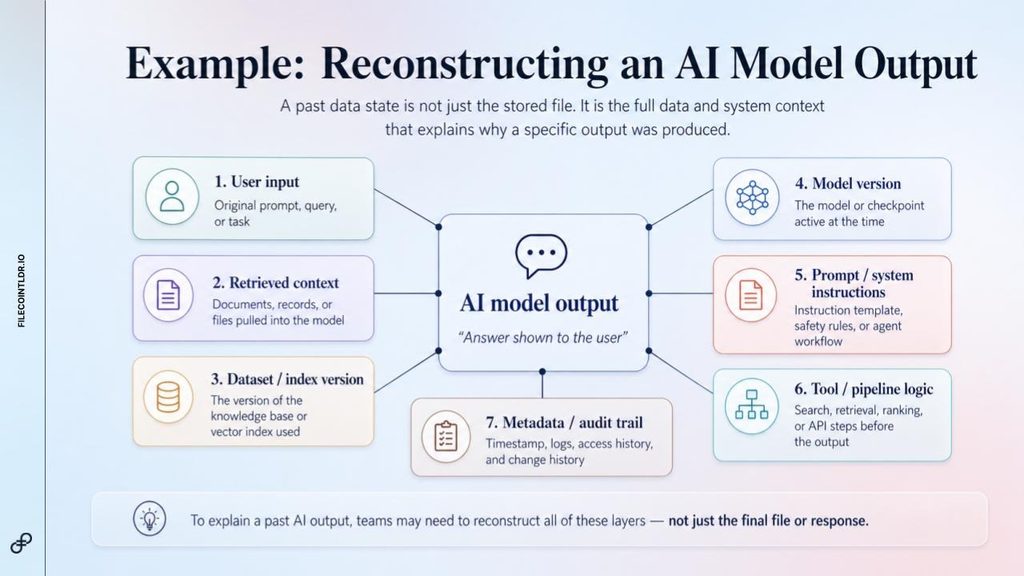
When that output needs to be investigated, keeping only the latest version is not enough. Teams need to reconstruct the earlier data state – including the dataset version, schema, labels, processing logic, metadata, and model context that were active at the time.
This is the past-data-state problem: the underlying files may still exist, while the broader context needed to explain, reproduce, or verify a result has been lost or scattered across different systems.
In this blog post, we’ll explore why this matters:
Modern data systems are in constant flux
AI and analytics demand reproducible states
Audits and compliance require trustworthy evidence of what actually existed at the time
We’ll then look at how Filecoin’s content addressing and verifiable storage can help anchor these critical data states over time.
1. Modern data systems are in constant flux
The first reason past data states matter is that modern data systems are rarely still. In AI and analytics workflows, data is constantly being updated, cleaned, labeled, combined, filtered, and reused across different tools.
A customer dataset may start as raw records from an app or database. Before it is used, the team may clean errors, add new fields, update labels, remove duplicates, or combine it with other datasets. Later, that same data may be used to train a model, power a dashboard, support a report, or feed an automated workflow.
Each change may be reasonable on its own. The problem is that, over time, these changes make it harder to know what the data actually looked like when a specific model output, report, or decision was produced.
Consider an AI credit model used to assess loan applications or repayment risk. If the model begins denying applications differently after an update, the team may need to determine which dataset, model version, labels, and decision logic produced the earlier results. Without access to that original state, it becomes harder to identify what changed, explain a decision, or roll the system back safely.
That is why modern data platforms increasingly talk about “time travel,” “data versioning,” and “lineage.” In plain terms, teams need ways to look back and see the version of the data that existed at a specific moment, not only the latest version available today.
A past data state is therefore more than a stored file. It includes the data itself, the labels attached to it, the rules used to process it, the version of the system that used it, and the context that gave it meaning. Without that context, teams may still have the data, but lose the ability to explain how it was used.
2. AI and analytics depend on reproducible data states
AI and analytics workflows are especially exposed to this problem because their outputs depend on many things working together at once.
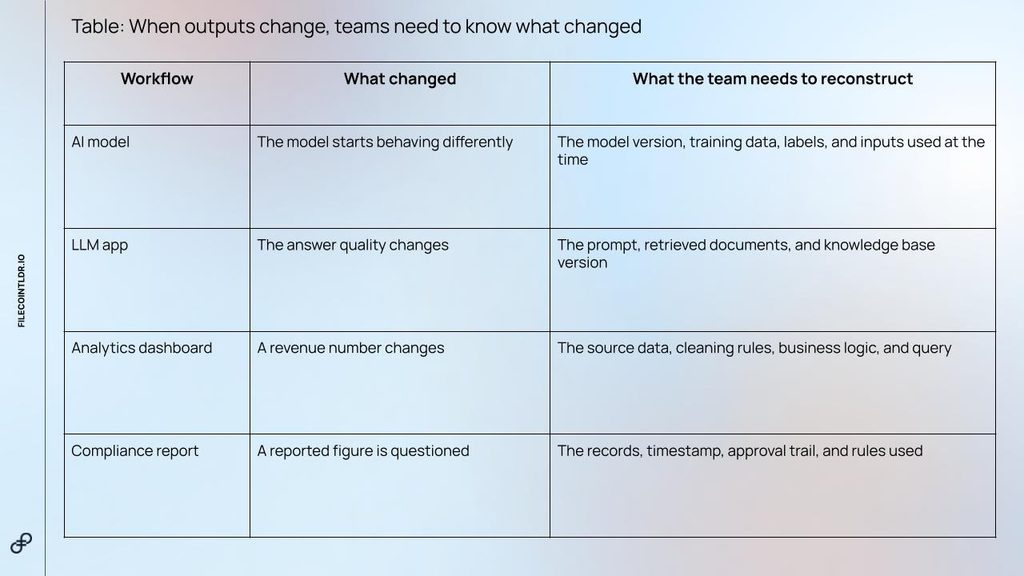
An AI model does not produce a result from “data” in the abstract. It uses a specific version of the data, a specific model, and a specific set of rules or instructions. An analytics dashboard is similar. A revenue number may depend on the source data, the way that data was cleaned, the business logic used, and the query behind the report. When any of these inputs change, the output can change too.
That is why reproducibility matters. If a model starts behaving differently after retraining, the team needs to know what changed. Was the model updated? Did the training data change? Were labels corrected? Did the retrieval system pull in different documents? Without the ability to return to the earlier version of the data and system context, teams may only be guessing.
This shows up in real AI incidents. In a 2025 postmortem, Anthropic explained that its privacy and security controls limited how and when engineers could access user interactions with Claude. Those controls protected user privacy, but they also made it harder for engineers to examine the problematic interactions needed to identify or reproduce certain bugs. The lesson is not that privacy controls are bad. It is that AI reliability often depends on having enough historical context to investigate what actually happened.
Analytics teams face a similar version of the problem. If a revenue dashboard changes after a data pipeline update, leaders need to know whether the business changed or the reporting logic changed. Without the ability to recreate the earlier data state, the team may struggle to explain why last month’s number no longer matches this month’s report.
This is why technical practices like experiment tracking, feature versioning, and data lineage matter. In plain terms, they help teams answer a simple operational question: can we go back to the exact data and system context that produced this result?
3. Audits and compliance require trustworthy evidence of what actually existed at the time
The third reason past data states matter is that some questions are not only technical. They are about evidence.
In an audit, investigation, compliance review, or disputed business decision, it may not be enough to show the data that exists today. The team may need to show what the data looked like at the time, which version was used, what changed later, and whether the original state can still be recreated.
In some regulated industries, this is already a formal requirement rather than simply a technical best practice. The SEC’s electronic recordkeeping rules, for example, require broker-dealers using an audit-trail approach to preserve records in a way that allows the original record to be recreated if it is modified or deleted. In January 2025, the SEC charged twelve firms with recordkeeping failures, resulting in $63.1 million in combined civil penalties.
Finance is one example of a broader operational need: as AI systems are used in more consequential decisions, organizations may increasingly be expected to show not only their current data, but the exact data and system state behind a past outcome.
This matters because business systems keep moving. Reports get updated. Datasets are cleaned. Fields are added or removed. Model inputs are changed. If no one preserved the earlier version, the organization may struggle to explain what a system actually knew when it made a decision.
Modern data platforms already recognize this need. Features like time travel, data versioning, and historical snapshots help teams look back at earlier versions of data. But these features are usually designed for short-term recovery and debugging, not multi-year audit timelines.
Time travel helps, but audit timelines can be longer
Platform
Typical retention window
Limitation
Snowflake
1–90 days
Historical data is no longer available for querying after the retention period ends
BigQuery
7 days + 7-day fail-safe
Time travel does not restore table metadata
Delta Lake
~30 days by default
VACUUM can permanently delete historical data files
The takeaway is not that these tools are weak. They are useful for fixing recent mistakes, checking recent changes, and rolling back short-term issues. But for datasets tied to audits, revenue reporting, model validation, or compliance, teams may need to preserve important versions for much longer.
That creates a gap between short-term recovery and long-term evidence. A system may be able to show what changed last week, but not the exact data version that supported a model, report, or business decision months or years ago.
For high-stakes data, the requirement is stronger: organizations need to preserve the right version, prove what existed at the time, and keep that evidence trustworthy long after the original system has moved on.
Bridging the gap with Filecoin
The missing layer is long-term proof.
Time travel, lineage tools, model registries, and audit logs can help teams understand which version of data was used. But over longer periods, teams also need confidence that the underlying files, snapshots, and records still exist and have not been silently changed.
This is where verifiable storage becomes useful. Instead of treating storage as a passive place where data sits, verifiable storage turns important data artifacts into something that can be referenced and checked over time.
Filecoin helps at this base layer through two ideas: content addressing and verifiable storage.
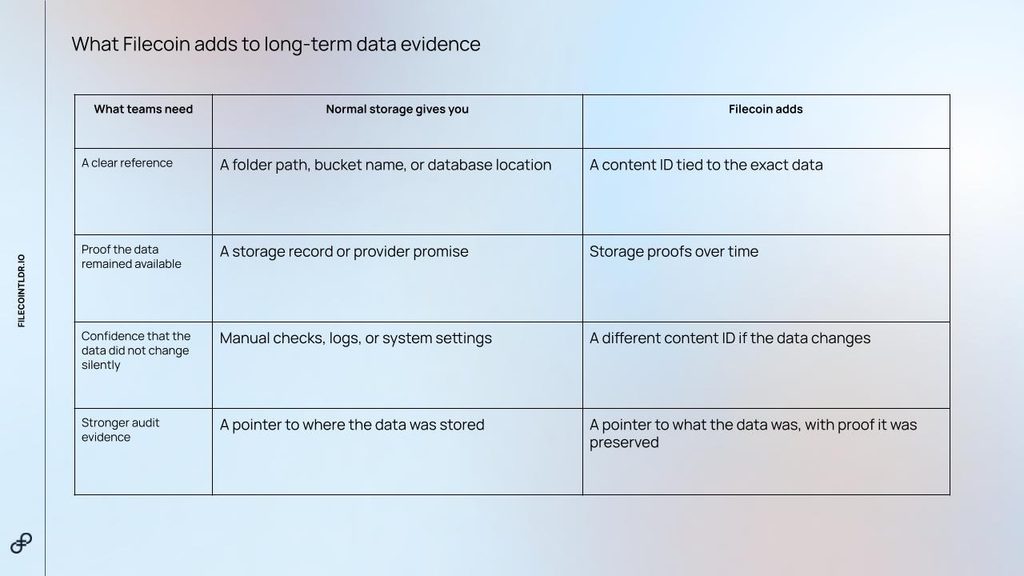
Through content addressing, important data artifacts can be referenced by what they are, not just where they are stored. A dataset snapshot, model artifact, evaluation set, audit log, or compliance record can be tied to a content identifier. If the content changes, the identifier changes too.
Verifiable storage adds another layer: evidence that the data has been stored over time. This gives teams a stronger way to preserve and later check the artifacts behind a model output, report, or business decision, even after normal time-travel windows expire.
For teams that already use cloud object storage, Fil One offers a more practical way to bring this into existing workflows. It provides S3-compatible object storage, so teams can connect existing tools, SDKs, and storage workflows without redesigning their entire data stack. When datasets or artifacts are uploaded, they can be tied to content identifiers and checked over time, giving teams a stronger record of what was stored and whether it still matches the original data.
Together, Filecoin and Fil One give teams a practical way to preserve important data artifacts beyond the normal lifespan of short-term recovery tools. Dataset snapshots, model artifacts, evaluation sets, audit logs, and compliance records can be stored, referenced, and checked over time. Filecoin provides the verifiable storage layer, while Fil One makes that layer accessible through familiar S3-compatible workflows.
Keep exploring Filecoin
Try Fil One – verifiable, S3-compatible storage on Filecoin, free for 30 days.
Follow FilecoinTLDR for ecosystem explainers and updates.
Start the Filecoin Quest Hub to learn, complete quests, and get involved.
Subscribe to the newsletter for future posts and insights.
Introduction
This article is part of FilecoinTLDR’s use case exploration series, where we look at real-world problems that Filecoin’s verifiable storage layer can help address.
Imagine an AI team preparing to retrain a model using a dataset archived six months ago. The files are restored, but something is off: some data does not clearly match the original version, metadata is incomplete, and a few labels no longer line up with the source data. The dataset looks usable, but the team cannot easily prove it is the exact version they meant to reuse. The issue is no longer just whether the dataset was restored. It is whether the team can trust it enough to build the next model on top of it.
This is the restored-data accuracy problem. For model retraining, investigations, research, audits, and compliance, older data only becomes useful if teams can verify that it still matches what was originally stored.
When that confidence is missing, the risk can become operational, compliance-related, and reputational. Current solutions like checksums, immutable storage, and restore testing help reduce the risk, but they are still partial mitigations. At scale, teams still need stronger ways to show that restored data has remained intact, unchanged, and independently verifiable over time.
In this blog post, we will look at three reasons this matters:
Old data is being reused, not just stored
Restores need to be proven, not assumed
Verifiable storage is becoming more important
We will then bring this back to Filecoin, and how verifiable storage can help make retained data easier to trust, prove, and reuse over time.
1. Old data is being reused, not just stored
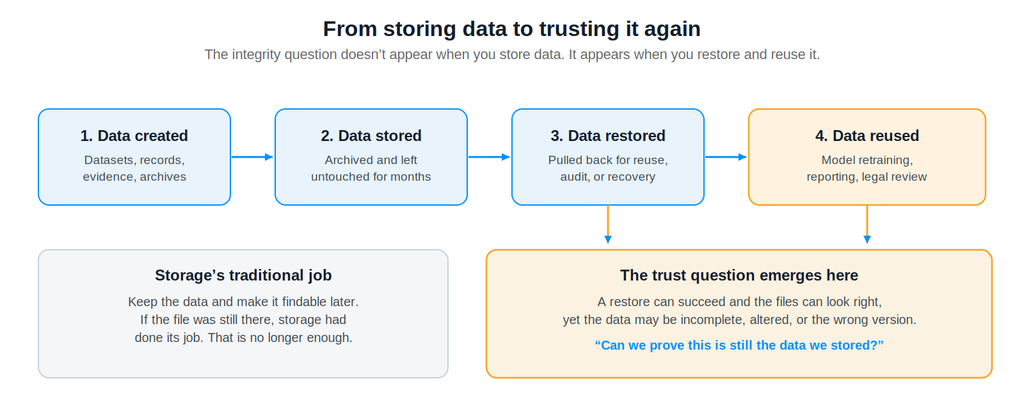
Archived data used to be judged mainly by whether it could be kept and found later. If the file, record, or dataset was still there when someone needed it, storage had done its job.
That standard starts to change when old data is brought back into use. A restored dataset for model retraining has to match the version the team intended to use. Audit records have to be complete and tied to the right time period. Research data has to be consistent enough for someone to reproduce the same result. Legal evidence has to come with a clear record of where it came from and how it was handled. In each case, the restore is not just about getting data back. It is about whether the restored data is reliable enough to support the next decision.
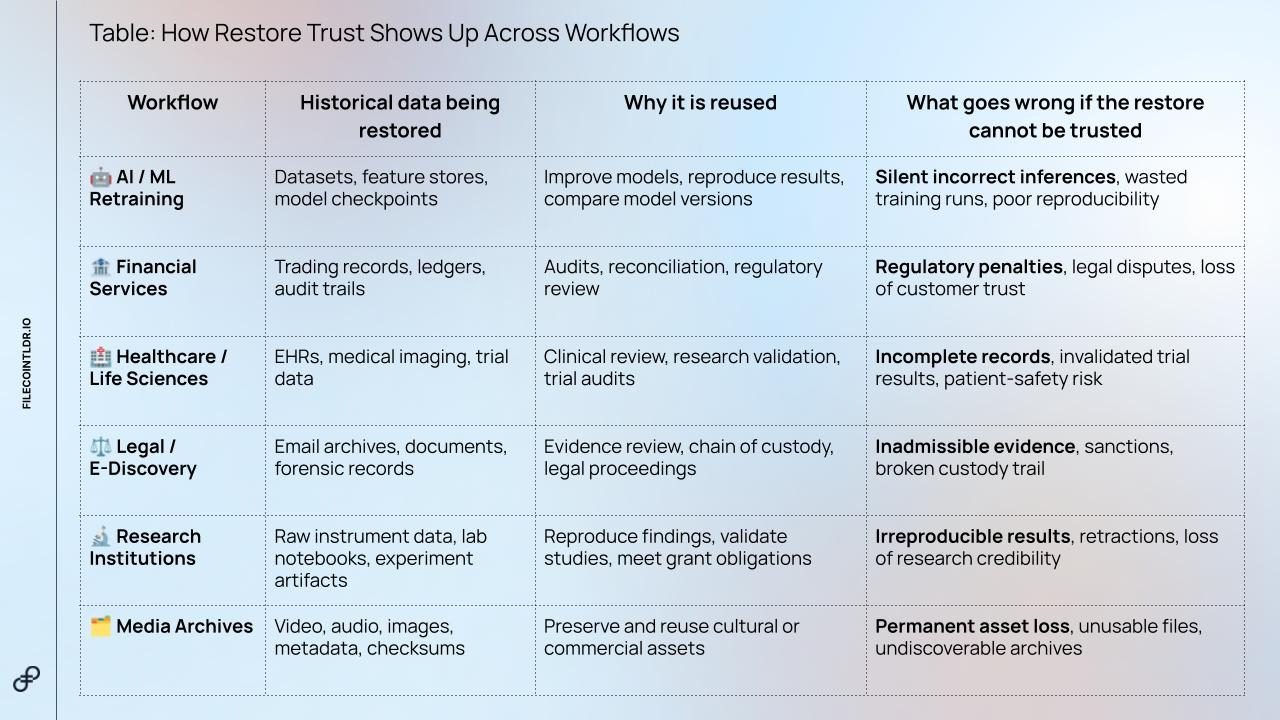
This shift shows up across very different sectors. The specific data changes, but the underlying question is similar: when historical data is restored, can the team trust it enough to use it again?
The pattern is clear: the restore moment is no longer just about access. It is a trust checkpoint. If the restored data cannot be verified, the next step becomes harder to defend, whether that step is model retraining, an audit, a legal review, or research validation.
2. Restores need to be proven, not assumed
The hard part about restored data is that failure does not always look obvious. A restore can finish successfully, files can show up in the right folder, and systems can come back online, while the data itself may still be incomplete, outdated, corrupted, compromised, or tied to the wrong version.
That is what creates the restore trust gap: the gap between believing recovery will work and being able to prove that the restored data is complete, correct, and usable when it matters.
Restore confidence often runs ahead of restore reality: A Veeam data resilience report found that while 90% of organizations expressed confidence in their ability to recover from a cyber incident, fewer than one in three ransomware victims fully recovered their data. On average, organizations recovered only 72% of affected data.
The point is not only that recovery can fail. It is that teams often discover the limits of their restore process only when the data is already needed.
This is especially clear in ransomware recovery. The U.S. National Institute of Standards and Technology (NIST), a widely cited cybersecurity standards body, warns that if a backup is created after malicious software has already affected the system, the backup may preserve the damaged version too. In that case, restoring from backup is not enough. Teams have to identify the correct backup version: the last clean version before the data was corrupted or compromised.
The question is not just “can we restore something?” It is “can we prove this is the right restore point?”
Real-world examples
GitLab, 2017: An accidental production database deletion exposed that several backup and replication methods were unavailable or had failed silently. GitLab ultimately restored from an older snapshot, resulting in around six hours of production data loss and an 18-hour outage. The incident showed that backup success is not the same as restore readiness: when recovery was actually needed, several assumed recovery paths were not usable.
City of Baltimore, 2019: After a ransomware incident, critical audit data was corrupted and could not support confidence in reported figures. The broader attack reportedly cost the city millions in recovery costs, but the sharper lesson here is that the problem moved from IT recovery into auditability, reporting, and public trust.
Usagi Forest AI, 2026: An AI agent accidentally deleted around 42,000 S3 objects. The team was able to recover only because S3 versioning had already been enabled, turning what could have been permanent loss into a recoverable incident.
These examples are different, but they point to the same issue: recovery is not just about whether data exists somewhere. It is about whether teams can prove that the restored data is still what it should be: complete, unchanged, tied to the right version, and reliable enough to use.
3. Verifiable storage is becoming more important
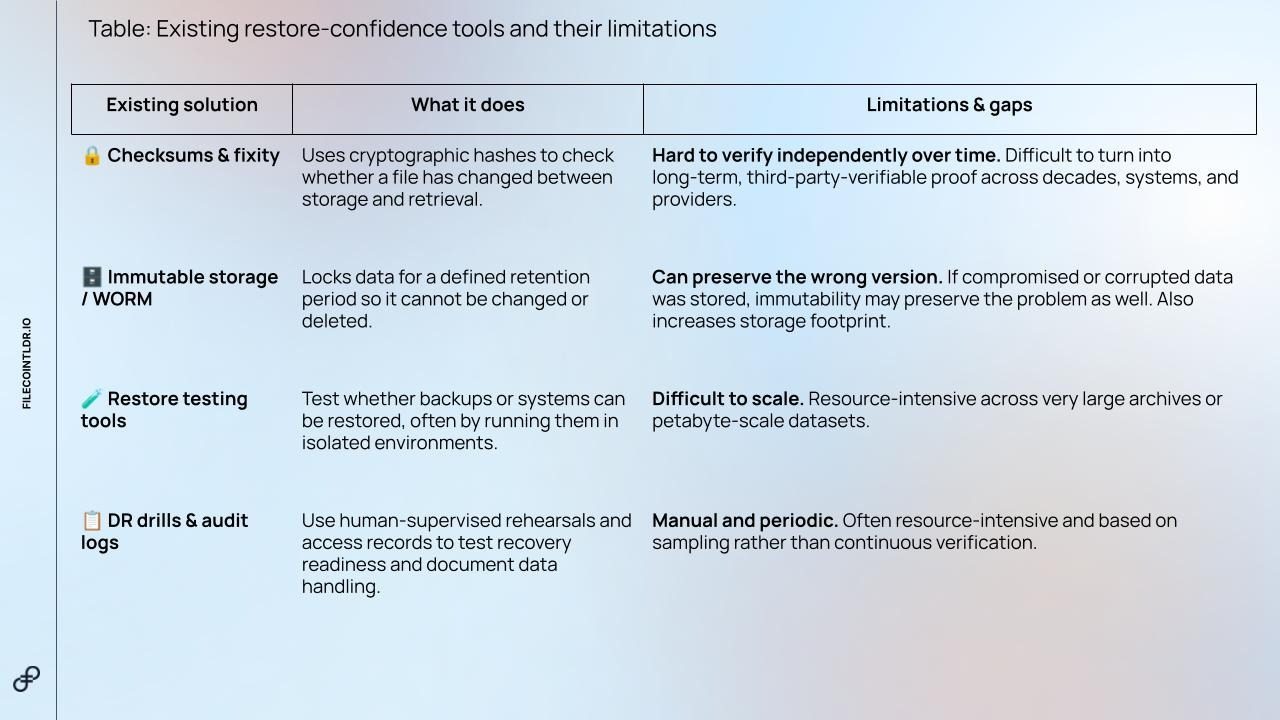
Teams are not starting from zero. Most organizations already use tools like checksums, fixity checks, immutable storage, restore testing, DR drills, audit logs, and backup platforms to reduce restore risk. These solutions already address parts of the restore trust problem, but each comes with trade-offs:
These controls exist for a reason. Data can become corrupted quietly, even in large and mature infrastructure systems. Meta has described silent data corruption as a real problem at modern scale, where hidden errors can spread across systems, create application-level issues, and take months to find and fix.
But even with controls in place, restore confidence becomes harder to prove as data grows larger, older, and more complex.
Some validation still requires human judgment. A checksum may show that a file has not changed, but it cannot tell whether the restored data is actually right for the application using it. A dataset may be intact at the file level, but still be paired with the wrong labels, schema, feature pipeline, model version, or business context.
Scale makes full verification harder. As datasets grow into millions or billions of objects, checking everything becomes expensive and operationally difficult. Metadata expands, restore times stretch, and teams may end up relying on samples instead of verifying the full archive.
At petabyte scale, verification becomes an economic question. The issue is no longer just whether verification is technically possible. It is whether teams can realistically verify enough of the archive, often enough, to trust it.
This is why the conversation starts to move from storage durability to verifiable integrity.
Durability asks whether the system is designed to avoid losing data. Verifiable integrity asks a harder question: can someone later prove that the data is still complete, unchanged, and tied to the right record?
As restored data becomes more valuable, that distinction matters. The future storage question is not only whether data can be retained or recovered, but whether its integrity can be proven over time.
Where Filecoin Fits
If the restored-data problem is partly a proof problem, then Filecoin’s value isn’t just that it stores data – it’s that it helps teams prove retained data has stayed intact over time. When a team restores old data, the first question is simple: is this the same data we stored before?
Filecoin is designed to help answer that. Content addressing helps verify that retrieved data matches what was originally stored, and storage proofs help show that storage commitments were maintained over time – instead of relying only on internal logs or provider claims. That matters because restored data is often trusted by people beyond the original team: auditors, partners, public institutions, researchers, future users.
Three layers of restore confidence
Identify the data through content addressing. Building on the model used by IPFS, data is identified by what it is, not just where it lives. If the content changes, the identifier changes—so teams can tell whether what came back matches what was stored.
Prove it was stored over time. Storage proofs, including Proof-of-Spacetime (PoSt), show that committed data continued to be stored rather than relying on a provider’s word.
Verify data presence for active data. Newer mechanisms like Proof of Data Possession (PDP) let providers prove they hold an accessible copy, so problems surface before retrieval, not during it.
A concrete example: Fil One
Much of this can sound abstract until it shows up in a product you can actually point your existing tools at. Fil One is one of the clearest examples: S3-compatible object storage, backed by Filecoin, that turns verifiable integrity into a default feature rather than a research concept.
Its core promise speaks directly to the restore-trust gap: rather than asking you to take its word for it, Fil One provides daily proof that your data is stored exactly as you uploaded it. Each dataset gets a unique content identifier (CID) at upload, and the system automatically re-checks the data roughly every 24 hours to confirm it still matches that original fingerprint. That is exactly the “is this still what we stored?” question, answered continuously instead of only at the moment of restore.
What Fil One offers
Why it matters for restored data
Daily CID integrity proofs
Auditable, 24/7 evidence that data hasn’t been altered – so integrity is proven continuously, not assumed at restore time.
S3-compatible API
Existing SDKs, CLIs, and workflows connect with little change, so verifiable storage doesn’t mean re-platforming.
No single-provider dependency
Data is spread across an independent network of providers, reducing the single points of failure behind many restore disasters.
11 nines of durability
Distributed, redundant storage with audit-ready visibility into integrity – pairing durability with provable integrity.
$4.99/TB/month, no egress fees
Predictable economics make it realistic to keep, and keep verifying – large archives over the long term.
For AI and data-intensive workloads, audit-sensitive data, multi-cloud strategies, and long-term retention, that combination is the point: durability and provable integrity, delivered through an interface teams already know.
This is already happening across the ecosystem
AI-native retained data: Projects such as Recall or Kite AI Projects such as Recall and Kite AI point to a growing need for AI systems to keep track of data, memory, and records over time. As models, agents, and datasets become more important to business workflows, more AI data will need to be identified, verified, and trusted later. This is where Filecoin’s strengths around content addressing, storage proofs, and long-term verifiability become increasingly relevant.
Enterprise-accessible storage: Akave Cloud is an S3-compatible, Filecoin-backed object storage platform that brings verifiable audit trails and policy-based access control into familiar storage workflows. Its work with 375ai shows how Filecoin-backed infrastructure can support data-heavy AI workflows where teams need to preserve data, control access, and maintain trust over time.
Public records: The Government of Bermuda announced an initiative with Filecoin Foundation, carried out in collaboration with Internet Archive, to upload public datasets to Filecoin as part of Democracy’s Library. The goal was to make critical public information more resilient, transparent, and verifiable over time.
Across these examples, the pattern is the same: Filecoin is most relevant where data needs to be preserved, verified, and trusted over time. That is why Filecoin fits the restored-data accuracy problem. Its value is not only storage capacity, but the ability to make retained data easier to identify, verify, and trust when it needs to be used again.
Keep exploring Filecoin
Try Fil One – verifiable, S3-compatible storage on Filecoin, free for 30 days.
Follow FilecoinTLDR for ecosystem explainers and updates.
Start the Filecoin Quest Hub to learn, complete quests, and get involved.
Subscribe to the newsletter for future posts and insights.
Introduction
This article is part of FilecoinTLDR’s use case exploration series, where we look at real-world problems that Filecoin’s verifiable storage layer can help address.
Autonomous vehicles and advanced robotics depend on machines being able to interpret the physical world. To train those systems, companies collect large amounts of raw data from cameras, LiDAR, and other sensors. That data then has to be labeled so models can learn to identify objects, movement, distance, road conditions, obstacles, and other real-world signals accurately.
This is where data-labeling companies come in. In autonomous vehicles and robotics, their role is not limited to tagging a few images and sending them back. It is also about ingesting, organizing, retaining, and retrieving massive datasets over time.
Step
What it means in practice
Ingesting
Receiving large raw datasets from autonomous vehicle or robotics teams, such as road video, LiDAR files, camera feeds, and other machine-captured data
Organizing
Sorting the data so it can actually be worked on, for example by vehicle run, location, sensor type, scene, project, edge case, or labeling status
Retaining
Keeping the data after the first labeling pass because it may still be needed later for QA, relabeling, retraining, audits, or rare edge cases
Retrieving
Pulling older data back when needed, such as revisiting nighttime pedestrian clips or checking the original raw sequence behind a completed label set
Seen this way, autonomous vehicle and robotics labeling is not just an annotation task. It is also a data-handling and storage problem. In this blog post, we will spotlight three realities shaping this segment:
1. Autonomous vehicle and robotics labeling involves much larger and heavier datasets than many people assume 2. Labeling video, LiDAR, and multimodal data is more complex than standard annotation workflows 3. At scale, archived data becomes a trust problem, not just a storage problem
And we will close with where Filecoin fits in this stack, and why it becomes relevant for retained data that still needs to remain durable, economically retrievable, and trustworthy over time.
1. The datasets are much larger and heavier than they first appear
The first thing to understand about autonomous vehicle and robotics labeling is that the workflow begins with a large volume of raw machine-generated data. Before any labeling work begins, teams already have to handle huge quantities of video and sensor data that need to be uploaded, organized, and prepared for review. At that point, the challenge is no longer just annotation. It is also the operational work of moving and managing heavy datasets from the start.
Autonomous vehicles (AVs) are evolving into mobile computing platforms, equipped with powerful processors and diverse sensors that generate massive heterogeneous data, for example 14 TB per day.” – AVS paper by arXiv, November 2025
This is not just a theoretical concern. Rivian, an electric vehicle maker developing autonomy features, has already described the problem in operational terms. In a 2025 AWS case study, AWS said Rivian’s data-collection test fleet generates terabytes of sensor and camera data every day, creating a real challenge for upload, storage, and processing.
BMW offers another example of what happens when storage cost becomes part of the workflow. In 2025, AWS said it worked with BMW on a petabyte-scale automated driving data lake and built a way to identify recordings for faster archiving based on access patterns. The point was not just to store more data, but to move less-active recordings into cheaper archival storage sooner, potentially within days of arrival rather than waiting for the standard 30-day transition period.
That matters because even before labeling, QA, or reprocessing begin, the scale of the raw data is already substantial. For teams working in autonomous vehicle and robotics workflows, the scale of the raw data alone starts to push the work beyond lightweight annotation and into a storage-heavy data operation.
2. Video, LiDAR, and multimodal labeling are harder than standard annotation
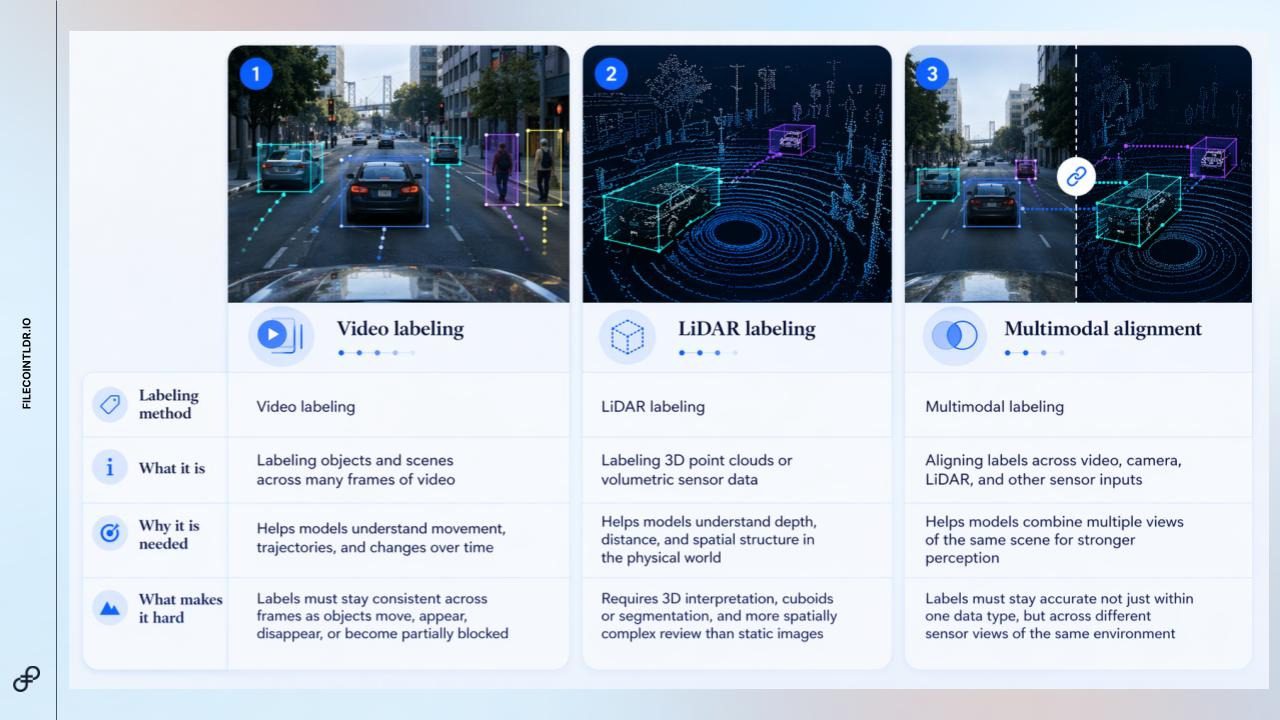
The second reality is that “labeling” in autonomous vehicle and robotics workflows is not one single task. Different systems require different types of labels depending on what the model needs to learn. Some tasks involve identifying objects across long video sequences, others involve labeling three-dimensional LiDAR data, and others require multiple sensor views of the same scene to be aligned together.
Taken together, these methods make the work more demanding than standard annotation. Video requires consistency across time. LiDAR requires spatial understanding in three dimensions. Multimodal workflows require labels to remain aligned across different sensor views of the same environment. For example, Waymo’s public perception data includes camera and LiDAR data, along with tasks such as 2D and 3D tracking and 3D semantic segmentation.
That is a useful reminder that this segment is not dealing with simple one-pass annotation jobs. It is dealing with richer perception data that often requires more specialized tooling, tighter review, and repeated revisiting of the same underlying datasets.
As a result, the storage layer matters more here than in lighter annotation workflows, because the data often needs to remain available for review, relabeling, and future model iteration.
3. Archived data becomes an unproven liability at scale
Once autonomous vehicle and robotics datasets start to accumulate, the challenge is no longer just where they are stored. It is whether teams can trust that the data will still be usable when they need it again.
Older data does not always stay active, but it rarely becomes irrelevant. Teams may need to restore past video clips, LiDAR scans, sensor logs, or labeled datasets for QA, relabeling, model iteration, edge-case review, audit support, or incident investigation.
This creates a restore confidence gap: the gap between believing archived data is safe and being able to verify that it is still intact, recoverable, and tied back to the correct source material or dataset version. That gap matters because many systems treat archive integrity as an assumption. Data is written, retained, and expected to be available later. But in high-stakes AV and robotics workflows, teams may eventually need to prove:
Can the original data be restored?
Does it match what was originally stored?
Is it tied to the right version, label, or model workflow?
Has it remained intact over time?
This is where storage becomes more than a cost center. Cost, retrieval fees, and retrieval speed still matter, but the deeper operational problem is confidence. Cheap storage is not enough if archived data becomes difficult to verify, expensive to restore, or unreliable when needed.
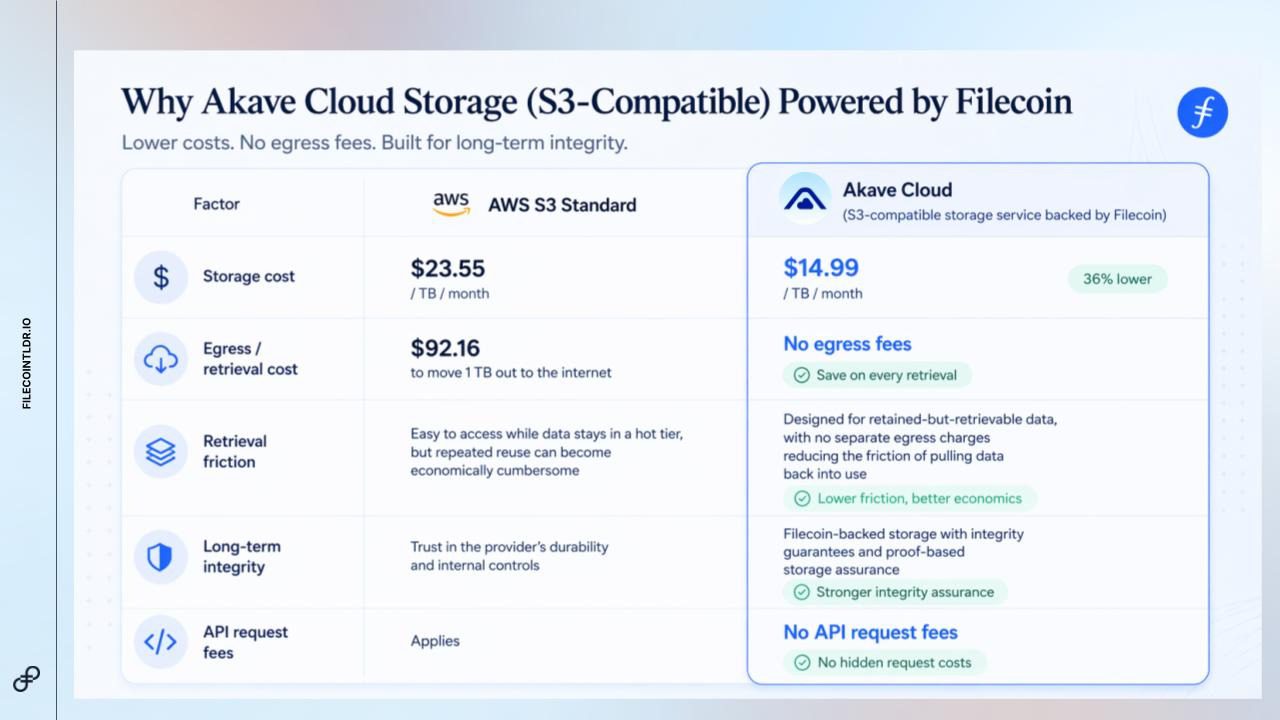
A simple comparison helps make the issue more concrete. Consider AWS S3 Standard alongside Akave Cloud, an S3-compatible storage service backed by Filecoin:
Fil One offers another practical path into the same Filecoin-backed storage layer, with S3-compatible object storage designed to fit existing data workflows without requiring teams to rebuild their storage stack.
For AV and robotics labeling, that distinction matters. Content addressing and provenance can help tie data back to exact files, versions, or dataset states. A decentralized storage network can also reduce reliance on a single provider or internal system.
The issue, then, is not just that storage gets harder at scale. It is that archived data becomes an unproven liability unless teams can verify that it remains retrievable, intact, and usable. This is where Filecoin’s relevance becomes clearer: it addresses the proof problem, not just the storage problem.
Conclusion
In conclusion, Filecoin’s relevance in autonomous vehicle and robotics labeling becomes clearer when these workflows are understood not just as annotation tasks, but as long-term data infrastructure problems.
Every video clip, LiDAR scan, sensor log, and labeled edge case can remain useful long after the first training run. Teams may need to revisit old labels, reproduce past datasets, investigate model behavior, or retain historical evidence for safety, QA, and audit purposes. In that context, the question is no longer just where the data is stored. It is whether teams can restore it with confidence.
That is where Filecoin’s role becomes more specific. It is not meant to replace every part of the AV or robotics data stack, but to support the retained data layer where durability, retrievability, and verifiability matter most. Through proof-based storage, content addressing, and Filecoin-backed services such as Akave Cloud, teams can begin to treat long-term data retention as something that can be checked and verified over time, not simply assumed.
As AV and robotics datasets continue to grow, the teams that manage their data foundations well will have an advantage. The future will not only depend on who can label data faster, but on who can preserve, restore, and trust the data their models continue to rely on.
Keep exploring Filecoin
Try Fil One – verifiable, S3-compatible storage on Filecoin, free for 30 days.
Follow FilecoinTLDR for ecosystem explainers and updates.